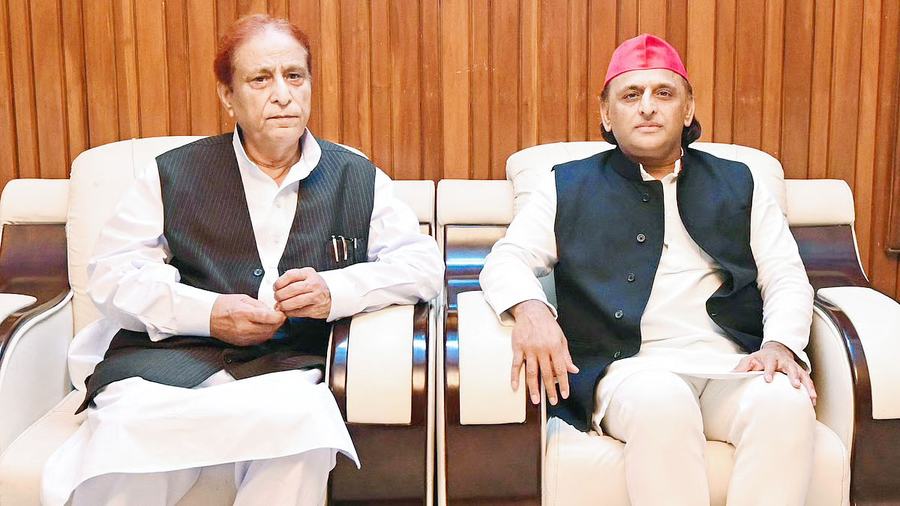
Akhilesh Yadav Faces Challenge of Retaining Muslim Votes in Uttar Pradesh Amid Azam Khan’s Absence
The relationship between the Samajwadi Party and Muslims has always been a subject of debate in Uttar Pradesh politics. The Samajwadi Party has traditionally enjoyed the largest political support among Muslims in the state, and this support has played a crucial role in its electoral victories on several occasions. However, ahead of the upcoming Assembly elections, Akhilesh Yadav appears to be facing a challenge that may not be easy to ignore. The challenge is to retain the Muslim vote bank, with the absence of Azam Khan emerging as a significant question.
Azam Khan’s name needs no introduction in Uttar Pradesh politics. For a long time, he served as a prominent voice for the Muslim community within the Samajwadi Party. His political influence and the support he commanded extended beyond Rampur to several other parts of the state. His political style and popularity among Muslims gave him a distinct identity compared to other Samajwadi Party leaders.
This raises the question of how Akhilesh Yadav will manage to keep Muslim voters aligned with the party without Azam Khan’s active role. Does the Samajwadi Party still have strong leadership and an effective political message capable of maintaining the same level of trust among the Muslim community?
It is also a fact that a large section of the Muslim community has traditionally viewed the Samajwadi Party as a strong political alternative to the BJP. However, opposition to the BJP alone cannot guarantee lasting support for any political party. Questions are increasingly being raised among Muslims about education, employment, security, political representation and the clarity of leaders’ positions on their concerns. Akhilesh Yadav will therefore have to understand that Muslim voters’ support depends not only on political calculations but also on trust and expectations.
Whether Azam Khan’s absence will have an impact limited to Rampur or influence the politics of the entire state remains to be seen. Azam Khan has his own political influence, and ignoring the sentiments of his supporters could prove costly for the Samajwadi Party. However, it is equally important to recognise that the political preferences of the entire Muslim community cannot be determined by the influence of a single leader. The community comprises people with diverse opinions, expectations and political priorities.
Another major challenge for Akhilesh Yadav is the politics of Asaduddin Owaisi. Owaisi has consistently raised issues concerning the political representation and rights of the Muslim community. If the Samajwadi Party appears unable to fulfil the expectations of Muslims, other political parties may attempt to capitalise on the situation. However, the actual electoral impact of Owaisi’s politics will become clear only in the coming days.
The Congress is also trying to strengthen its political base in Uttar Pradesh. This could intensify discussions among Muslim voters about different political alternatives. Akhilesh Yadav’s challenge will not simply be to confront his political opponents but also to maintain the confidence of his existing supporters.
It would not be wrong to say that Azam Khan’s absence could become a political challenge for the Samajwadi Party. However, the extent of the damage to Akhilesh Yadav’s electoral prospects will depend on how effectively he addresses the concerns and expectations of the Muslim community. He will have to demonstrate that the Samajwadi Party does not turn to Muslim voters only during elections but is also genuinely committed to their political, social and economic interests.
Retaining the Muslim vote bank in the upcoming Assembly elections will not be easy for Akhilesh Yadav. Amid Azam Khan’s political legacy, Owaisi’s activities and the Congress’s electoral strategy, Akhilesh Yadav will have to strike a new political balance. The question now is whether he can maintain the trust of the Muslim community as before, or whether Azam Khan’s absence will significantly affect the Samajwadi Party’s electoral equations.
Email: shiblirampuri@gmail.com