Modi’s Claims at the Bloomberg New Economy Forum: A Contradiction Between Words and Reality
The growing public opposition to the government has apparently unsettled the ruling establishment. The opposition alliance, INDIA, also appears to be standing united. On the one hand, the opposition parties have levelled allegations against the government for which, they maintain, substantial evidence has emerged in the public domain, and the Modi government is facing severe criticism even in the international media. On the other hand, instead of presenting a substantive defence, those holding positions of responsibility in the government are targeting opposition parties, particularly the Congress and Rahul Gandhi, with what their critics describe as baseless allegations. Such conduct is reminiscent of the saying, “A guilty conscience needs no accuser,” and reflects an attempt to deflect attention from uncomfortable questions.
Instead of answering allegations made by their opponents, countering them with accusations may be a way of responding to fear, insecurity or a sense of guilt. However, such a response cannot, under any circumstances, be regarded as proof of an accused person’s innocence. This is why, the argument goes, those in power are becoming entangled in their own web. If a person is accused of an offence, a criminal case is filed against them and they are brought before a court, their defence cannot be based merely on making allegations against the prosecution.
The conduct of Prime Minister Narendra Modi and his close associate, often described as his “Chanakya”, Union Home Minister Amit Shah, appears to reflect a similar pattern of political defensiveness and anxiety.
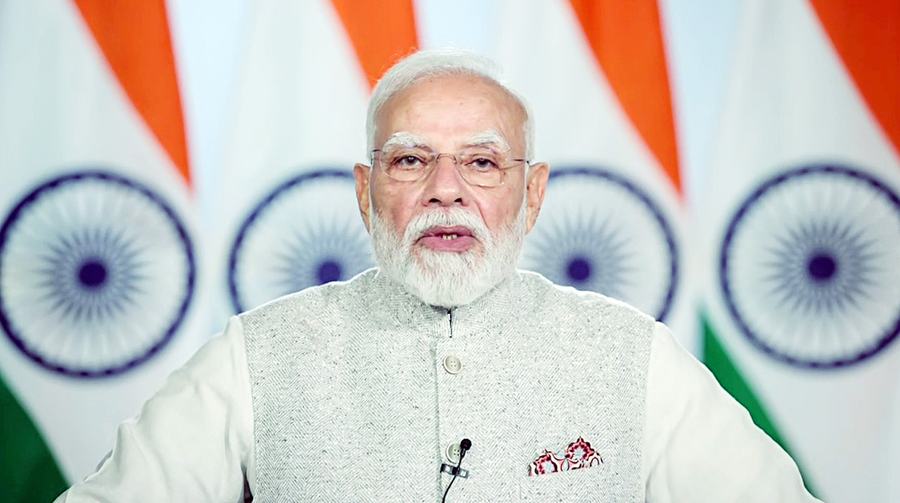
Consider Prime Minister Narendra Modi’s recent remarks at the Bloomberg New Economy Forum. In his address at the event on October 13, Modi appeared to disregard ground realities to such an extent that his statements, according to his critics, bore little resemblance to the facts. His remarks seemed to be at odds with the available evidence and amounted, in their view, to an attempt to gloss over the truth with a layer of rhetoric.
Before examining his speech, it is important to understand the purpose of the forum. In brief, it seeks to foster partnerships between governments and the business community, focus on new and emerging economies, and facilitate discussions on challenges confronting key economic sectors.
Against this backdrop, let us examine the prime minister’s address. Modi referred to the economy, technology, energy and several other subjects. However, the point he emphasised most strongly appears to have little connection with the policies pursued by his own government. After describing these economic areas as important measures of strength, he asked what the ultimate purpose of that strength should be. In answering his own question, Modi made statements that, critics argue, are inconsistent with the economic policies and decisions taken during his nearly 12 years in power.
He emphatically declared that “the purpose of this strength should not be to empower just a few people.”
Yet the world is well aware of allegations that, under Modi’s tenure, the country’s resources and technology-related projects have increasingly served the commercial interests of a handful of industrialists, particularly two prominent business groups. Why, for instance, has the entry of Starlink into India been subject to delays and various obstacles? Even setting Starlink aside, is it not the government’s responsibility to provide other industrialists with opportunities to compete and expand in the Indian market?
Critics have also repeatedly questioned the manner in which Modi has allegedly used his office to facilitate the expansion of Gautam Adani’s business interests. These concerns have attracted attention not only within India but also internationally.
The prime minister claimed that the vision with which he had come to the forum was the “power of empowerment”. If by “others” he means Mukesh Ambani and Gautam Adani, then the argument ends there. But if he is speaking sincerely, the record of his government suggests a very different picture. From the economy to other sectors and even politics, critics argue, the government has acted in ways that have restricted the authority of others and weakened their ability to operate independently.
This includes economic power, the power of ordinary citizens in a democracy and the political strength of those who oppose the government. By concentrating authority and influence in the hands of a few, the Modi government has certainly not strengthened the democratic system of which the country is proud.
In such circumstances, claiming to be working with a vision of empowering others is not merely disconnected from reality; critics would argue that it runs contrary to the government's record.
The prime minister further stated: “The idea of the power of empowerment is not merely a sermon to the world; it is a deep civilisational tradition that is being incorporated into the country’s governance and working methods.”
Can even a trace of truth be found in this statement when measured against the government's actual conduct? Modi may believe that his words amount to more than mere preaching, but the reality, according to his critics, is that they are little more than a sermon delivered without corresponding action.
Modi described Indian democracy as the “mother of democracy”. In principle, the description may have historical and philosophical significance. However, the extent to which this very democracy has allegedly been undermined over the past decade or more is now a matter of concern not only within India but also internationally.
What kind of democracy is it when the autonomy of the Election Commission, the judiciary and other constitutional institutions is curtailed, leaving them vulnerable to government influence? This is a question to which Modi may find it difficult to provide a convincing answer.
In his address, Modi also declared that “the purpose of power is not merely to control others”.
Yet, just two and three days before he delivered this speech on October 13, the Delhi Police had allegedly used force against peaceful protesters in the capital, undermining their democratic right to demonstrate. From the ruling party to the Union Home Minister, attempts were being made to justify the police action with arguments that, critics contend, reflected an authoritarian approach.
If this is not an example of authoritarianism, what is? The Home Minister was attempting to portray peaceful protests by the Congress and other opposition parties as anti-national activities, describing them as efforts to “protect infiltrators”.
What should one call an attempt to discredit a person from a prominent political family who occupies the constitutional position of Leader of the Opposition by portraying him as a supporter of infiltrators? And what does it mean when constitutional institutions, which are supposed to function independently of the government, appear reluctant to listen to his concerns?
Is this not an attempt to concentrate power in a few hands and transform democracy into a system characterised by authoritarianism and the suppression of dissent?
The important point is that the Home Ministry has not, according to the opposition's account, produced evidence sufficient to substantiate these allegations. Meanwhile, opposition parties, including Rahul Gandhi and the Congress, have raised concerns about the government, the Election Commission and certain judges of the Supreme Court, claiming that evidence supporting their allegations has emerged in the public domain.
Despite these controversies, Modi continues to assert that his government is committed to empowering others. On what basis, then, should this claim be accepted as an accurate reflection of reality?
The prime minister also claimed that, a little over a decade ago, access to mobile phones and the internet was available only to privileged sections of society.
Clearly, he wishes to present the expansion of mobile phone and internet usage in India as an achievement of his government. However, the falling cost of technology and the expansion of digital access are part of a global trend driven by technological progress, market competition and wider infrastructure development. It would therefore be misleading to attribute these developments exclusively to any one government, particularly the Modi administration.
In his speech, the prime minister also referred to the steps allegedly taken by his government to eliminate corruption. Yet critics point to what they describe as a recurring pattern: a person whom Modi or members of his party condemn as deeply corrupt may subsequently join the BJP or its political alliance, after which the earlier allegations appear to lose their political significance.
Can such a practice genuinely be presented as an effective measure to combat corruption?
In his address, Modi said: “The real question is not who holds power, but how that power is being used.”
Mr Modi, this is precisely the question that the people of India and the media are asking you. How is the power entrusted to your government being used?
If the authority granted by the people in the name of democracy is used to suppress those very people, can that be described as the proper exercise of power? Clearly, it cannot.
The implication is that the principles articulated by the prime minister at the forum have not, according to his critics, been reflected in the actions of his government. They argue that the fear of losing power is driving the government towards increasingly forceful measures to preserve its position.
In their view, this is not evidence of a commitment to empowering others, but rather an indication of the political insecurity surrounding the government.
Email: naqvisiraj58@gmail.com
Mobile: 9811602330