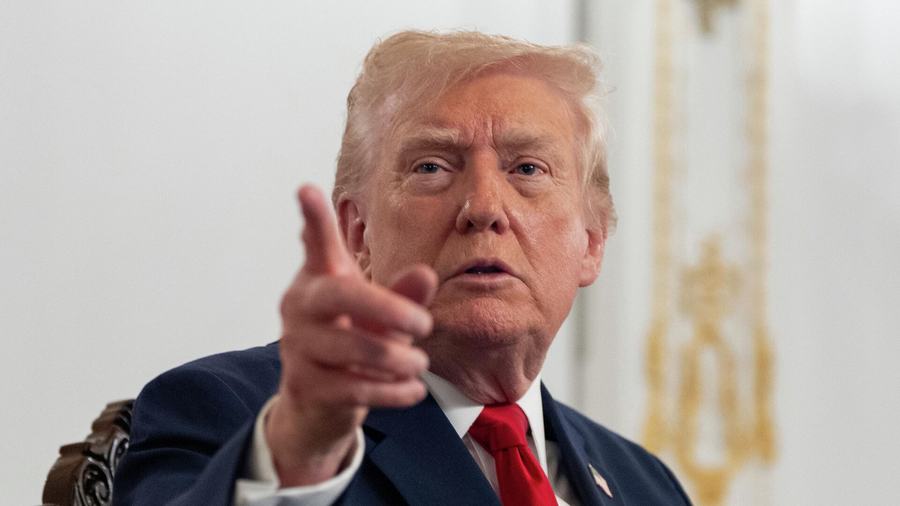
The Significance of Trump's Setback in the House of Representatives
Midterm elections are scheduled to take place in the United States this November, but Trump has already suffered a major blow in the House of Representatives. By passing a resolution regarding the President's war powers last Tuesday (September 15), the House has made it clear that Trump should brace himself for a defeat in the November elections. Although it is highly unlikely that Trump’s presidency would be in jeopardy even if he loses the midterm elections, it is certain that such an outcome would create obstacles for the Trump administration in making various decisions and would force his party to face the consequences. Notably, during the vote in the House of Representatives to curtail Trump's war powers, seven members of his own Republican Party voted in favor of the resolution introduced by the Democrats. This clearly indicates that Trump is becoming increasingly isolated within his own party and his support base is shrinking.
Last Tuesday, Democratic lawmaker Seth Moulton introduced a resolution in the House calling on Trump to halt hostile actions against Iran and withdraw U.S. troops. The resolution passed with 220 votes in favor and 204 against; however, a significant aspect of the vote was that seven members of the ruling Republican Party were among those supporting the measure, while one independent lawmaker voted against it. Although this resolution does not legally compel Trump to immediately cease hostilities against Iran—given the extensive powers vested in the U.S. President—it nonetheless... Two similar resolutions have recently passed in the US House of Representatives, yet they had no impact on Trump’s war policy or his intentions; consequently, the conflict continues on a limited scale. It is a separate matter that Trump’s obstinacy regarding the continuation of the war has caused significant damage to the US in every respect. A similar resolution was passed in June of this year, with four members of Trump’s own Republican Party supporting it. The very next month—July—another similar resolution was introduced, and the Trump administration faced defeat once again. The same four Republican lawmakers who had voted against Trump on the June resolution supported the Democratic-led resolution this time as well. However, the significant aspect of the resolution introduced last Tuesday is that the number of his opponents within his own party has risen from four to seven. This clearly indicates that opposition within Trump’s own party is growing and his position is weakening. For this reason, predictions are being made that Trump will lose the midterm elections. While the defeats Trump suffered regarding these resolutions may not translate into major tangible setbacks on the ground, such resolutions are certainly regarded as symbolic within the US legislative framework. In this sense, despite their symbolic nature, they offer a glimpse into Trump’s future. The crucial point is not merely the immediate impact of these resolutions on Trump’s executive powers; rather, the more pressing question is how he will manage to complete his term if this trend persists into the November midterm elections. A defeat in the midterms would trigger a host of issues, including challenges to Trump’s authority—a matter that was analyzed in a previous column. Beyond all other factors, it is worth noting that Trump’s domestic setbacks are weakening his standing internationally as well. Neither the American public nor the rest of the world takes Trump’s pronouncements seriously anymore. While Americans are aggrieved that Trump sacrificed U.S. troops for the sake of Israeli interests, a recent report detailing the massive financial and defense-related losses the U.S. has suffered in the ongoing conflict has further undermined his domestic position. The report reveals that, as of August 1st, the U.S. had incurred losses totaling approximately $38 billion due to this war. Needless to say, this staggering sum deals a severe blow to America’s already precarious economy; furthermore, there are additional financial losses that were not included in the report. It also indicates that if the conflict persists, the U.S. could face additional expenditures of $2 to $3 billion. Setting aside the views of international defense analysts, even American analysts themselves have acknowledged that the U.S. has lost this war and sustained heavy financial and military damage. Clearly, there is no prospect whatsoever of recovering the credibility America has squandered in this conflict. What is particularly concerning for Americans and their defense experts is that Trump continues to harbor the misconception that a military campaign is necessary to counter the threat posed by Iran. There is no need to reiterate what the U.S. has lost in the military campaigns conducted so far; relations between the U.S. and NATO have been shattered, U.S. military bases in the Middle East are on the verge of collapse, and American troops are resorting to various tactics to escape the conflict. As for U.S. arms stockpiles, the report indicates that the U.S.... It could take arms manufacturers more than three years to replenish the army's weapons stockpiles. US defense officials have acknowledged that a war with Iran would involve the large-scale use of ammunition...