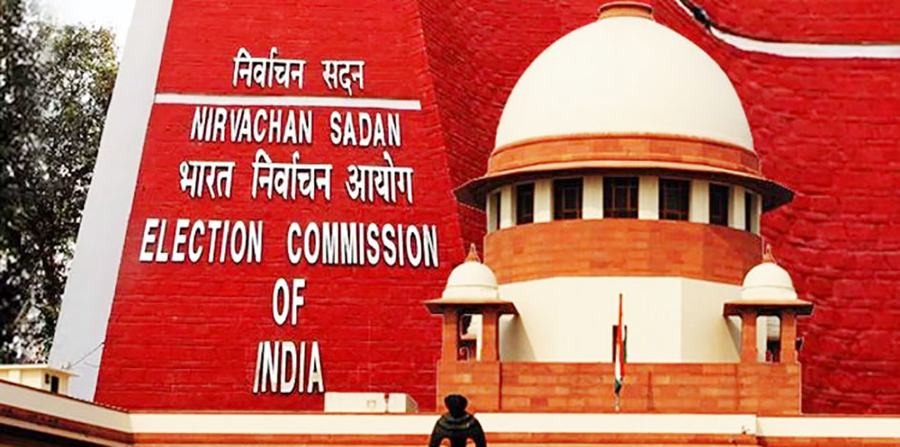
Election Commission Faces Tough Questions from Supreme Court Over Controversial SIR Exercise
The Election Commission is increasingly finding itself in a difficult position because of several controversial decisions it has taken in matters that are now being heard by the Supreme Court. The court's observations suggest that it is unhappy with a number of the Commission's decisions. However, it would be premature to conclude that the Supreme Court's eventual verdict in these cases will play a significant role in removing the current Election Commissioner from office. There have been several instances in the past when the court made strong remarks against the ruling party or the government while hearing petitions challenging their actions, but its final judgments, for various reasons, did not necessarily reflect the same stance as its initial observations.
During the hearing of petitions filed by various parties against the Election Commission, a bench headed by the Chief Justice questioned the Commission sharply last Wednesday. The bench asked why people whose names were already on the electoral rolls had been compelled to fill out Form 6 afresh.
It is worth noting that Form 6 is intended for registering new voters on the electoral rolls. Its purpose is to include the names of people who have attained the age of 18, as well as voters who have changed their addresses and need to have their names registered at their new residences. However, during the Special Intensive Revision (SIR) of electoral rolls, several legal aspects relating to the use of Form 6 appear to have been overlooked, and even existing voters were compelled to fill it out.
My own experience in this regard is worth considering. My name had been included in the electoral roll for the constituency covering my residence for two decades. I had also cast my vote in the 2024 parliamentary elections on the basis of that very electoral roll. However, during the SIR exercise in Uttar Pradesh, my name disappeared from the voter list.
It is difficult to say who removed my name and why. However, the Booth Level Officer (BLO) concerned told me not to worry and advised me to fill out Form 6, assuring me that my name would be included in the electoral roll. That is precisely what happened.
But the question remains: if a person had cast a vote in the previous parliamentary election, who is responsible for removing that person's name from the electoral roll? Clearly, when the voter has neither requested the removal of their name nor changed their address, why should they be compelled to fill out Form 6?
Moreover, the form contains several questions that, from a legal standpoint, should not be asked of an existing voter in these circumstances.
The Supreme Court has raised precisely this issue with the Election Commission in a stern tone, asking: "Why are people who were already registered as voters but whose names were omitted from the new draft electoral rolls being compelled to fill out Form 6?"
The problem is that those who fill out this form are treated as new voters, which is contrary to the facts and could expose them to allegations of making false declarations. Yet, if they have been compelled to do so by a constitutional body such as the Election Commission, the responsibility for this situation must also rest with the Commission.
Responding to the court's question, the Commission's counsel argued that, from an administrative perspective, people whose names did not appear on the new draft electoral rolls were being treated as starting afresh under the SIR process. Therefore, they had been placed in the category of first-time voters.
The Supreme Court, however, took a stern view of this argument, pointing out that these people had already been included in the electoral rolls.
At this stage, Prashant Bhushan, counsel for one of the petitioners, drew the court's attention to a serious legal dilemma. He pointed out that anyone filling out Form 6 is required to make an oath-bound declaration that they have never previously been registered as a voter.
Clearly, this amounts to compelling an existing voter to make a false declaration. The Election Commission is facilitating this process, and there is little need to point out that such an allegedly unlawful practice is being carried out under the authority of a constitutional institution.
This is why the Supreme Court has questioned both the Commission's conduct in this matter and its position regarding Form 6.
It is difficult to predict how the Election Commission will defend itself at the next hearing. However, this is by no means the only issue that raises questions about the SIR exercise being conducted by the Commission. The reality is that the process so far has been marred by various irregularities, procedural lapses and alleged unlawful practices. The revelations emerging almost daily have seriously damaged the Commission's public image.
The manner in which the government has stood by the Commission in this matter has strengthened the impression that the entire exercise was undertaken with the intention of giving the ruling party an electoral advantage.
It is not as though the SIR exercise is being conducted for the first time in India. Similar revisions have been carried out eight times since Independence. However, never before has the process generated such widespread controversy, nor have irregularities involving the deletion of voters' names been reported on such a scale.
The removal of some outdated entries and the inclusion of people who have turned 18 are routine aspects of electoral roll revision. However, the deletion of names on a massive scale, reportedly involving more than a billion voters, along with the removal of names belonging disproportionately to certain communities or social groups, cannot be regarded as a normal exercise. The possibility of organised irregularities or deliberate manipulation behind such developments cannot be ignored.
The latest controversy concerns the reported deletion of nearly one crore voters' names from Karnataka's electoral rolls. Consider the scale of the issue: if the names of nearly one crore voters are removed from the electoral rolls of a state with approximately 5.5 crore voters, does this represent a genuine exercise in electoral roll revision, or could it be the result of an attempt to alter the political balance through a deliberate conspiracy?
In Maharashtra, too, the Supreme Court has issued a notice to the Election Commission over the SIR exercise, seeking its response on several issues. The notice was issued in response to a petition alleging that nearly three crore names had been removed from the electoral rolls during the revision process in a state with approximately nine crore voters.
What do such actions by the Election Commission ultimately demonstrate? Is the Commission operating on the principle that voting rights should effectively be restricted to supporters of a particular political ideology? Can claims that such a large number of people in the country are ineligible voters be accepted without compelling evidence? Were the cases of the voters whose names were deleted properly examined before their names were removed? If not, why not?
These are fundamental questions because the issue concerns the deprivation of citizens of their basic right to vote in a democratic country. Accepting the constitutional or legal justification for such a large-scale exercise without adequate evidence or convincing arguments would amount to little more than a crude mockery of democracy.
A report from Uttar Pradesh has also raised serious concerns and further deepened suspicions about the SIR process. According to the report, the name of a voter named Vikas Yadav was found listed 13 times on the electoral rolls in Azamgarh district.
The Uttar Pradesh Chief Electoral Officer has reportedly ordered strict action against the district's election officials and directed that the electoral rolls for the entire district be examined afresh.
However, an important question remains: when similar irregularities have been reported in other states across India, have the Election Commission or the respective state election authorities taken comparable action there as well?
What is particularly troubling is that, despite all these irregularities, the Election Commission is not even prepared to disclose which software it used to identify errors and discrepancies in the electoral roll data.
In response to an application filed under the Right to Information (RTI) Act, the Commission reportedly offered a weak justification, stating: "This matter falls under commercial confidence, trade secrets and intellectual property and is therefore exempt from disclosure under the RTI Act."
Arguments of this kind create the impression that there may be something to conceal, much like the proverbial expression that a guilty person always has something to hide.
In any case, the matter is now before the Supreme Court. It remains to be seen what arguments the Election Commission presents in its defence and whether the sternness reflected in the court's recent observations will also be evident in its final judgments on the petitions.
Email: naqvisiraj58@gmail.com
Mobile: 9811602330