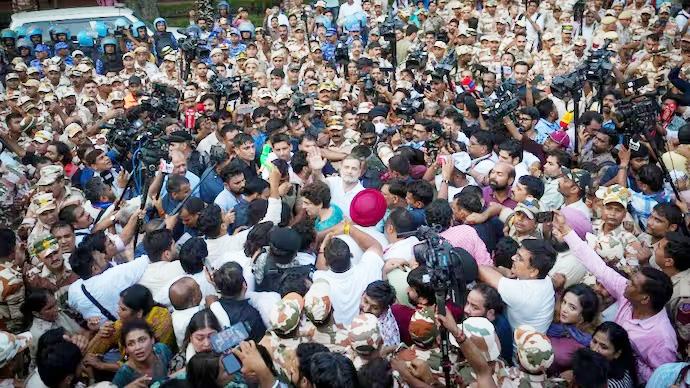
Protests against “vote theft” are continuing across India. Alongside Generation Z, the opposition is also taking to the streets to fight for its rights. For the first time, a movement of such a large scale has emerged against what critics describe as the government’s authoritarianism. The opposition has been consistently demanding the resignation of the Chief Election Commissioner. On October 12, a petition was filed in the Supreme Court challenging the Special Intensive Revision (SIR) process. The Congress party marched to the Supreme Court as part of its protest. It was a historic march whose echoes must have reached not only the corridors of power but also the highest court of the country.
Movements against the government have emerged in the past as well, but either they were ignored or discredited and eventually brought to an end. The farmers’ protest continued for more than a year, yet Prime Minister Narendra Modi did not even meet the farmers’ leaders. Hundreds of people died during the movement. Farmers remained under the open sky at Delhi’s borders, enduring scorching heat and bitter cold, but the government remained unmoved. To make matters worse, a large section of the urban population in India began to view the farmers as instruments of the opposition and the trading community. Apparently, the government was confident that the majority of the country stood behind it, which is why the farmers’ agitation continued to be ignored.
The second major movement during Modi’s tenure began at Shaheen Bagh. Women staged a sit-in at Shaheen Bagh against the implementation of the Citizenship Amendment Act (CAA) and the National Register of Citizens (NRC). Since this movement concerned the very existence and identity of Muslims, the government and saffron organisations made every effort to discredit it. The women of Shaheen Bagh were subjected to all kinds of accusations and insults. Protesters were labelled “urban Naxals”. The Prime Minister began suggesting that rioters could be identified by their clothes. BJP ministers openly issued threats to shoot people.
Neither human rights organisations came forward in response to these incidents nor did the Supreme Court take suo motu cognisance of the matter. Even during court proceedings, constitutional principles appeared to be overlooked, much as faith was given precedence over the Constitution in the Babri Masjid verdict. The Shaheen Bagh movement came to an end because of COVID-19, but the government and its supporters declared it a failure.
Thereafter, organised attacks on Muslim identity and places of worship began. Incidents of mob violence increased steadily. Even travelling by train or bus no longer remained safe. Questions continued to be raised about the role of the government and the administration in these incidents. Meanwhile, sections of the younger generation also began to believe that a community stereotyped as a “people who repair punctures” deserved such treatment.
However, when the education system came under attack and young people began to see their future growing increasingly bleak, a movement emerged for the first time that was not confined to any single class, community or group. When Chief Justice Surya Kant compared the younger generation to “cockroaches”, the young people took to the streets in large numbers, much like cockroaches. One consequence of this movement was that, for the first time during Modi’s tenure, a minister was compelled to resign, albeit reluctantly.
The fundamental objection to the SIR process is that it is allegedly facilitating “vote theft”. Reports have emerged from various states about large-scale deletions of voters from electoral rolls. Even eligible voters have faced legal and procedural complications. Particular concern has been expressed over the deletion of votes belonging to Dalits and Muslims.
Sadly, however, no effective voice of protest has emerged from the Muslim community on this issue. Muslim leaders and religious scholars have also been largely absent from any prominent protest. It is equally important to raise awareness among Muslims about their leaders and religious scholars. Questions have repeatedly been raised about the association of a considerable number of them with the RSS and its affiliated organisations, such as the Muslim Rashtriya Manch. Therefore, rather than accepting their statements at face value, their positions and affiliations must be examined seriously. Wherever their statements or actions appear to conflict with the interests of the community, they should be held accountable so that the tendency to sell out the community’s interests can be curbed.
A protest was scheduled to take place at Jantar Mantar on October 10, but the police detained several prominent leaders. Abhijeet Deepke and his associates were reportedly prevented from even disembarking from their flight, while reports emerged that Dhruv Rathee had been detained from his residence.
The closure of metro stations and public transport services in Delhi ahead of the protest also raised several questions. Numerous trains carrying passengers to Delhi from different states were reportedly cancelled as well. Reports indicated that more than 20,000 police personnel had been deployed at Jantar Mantar.
If only such a large number of police personnel had also been deployed in Manipur, perhaps the loss of life could have been reduced. Similarly, if effective security arrangements had been in place in Pahalgam, it might have been possible to save the lives of innocent tourists.
Nevertheless, on October 10, protest activities were witnessed in various parts of the country. Demonstrations were held in different states on October 11 as well. On October 12, opposition leaders marched on foot from Barakhamba Road to the Supreme Court and filed a petition challenging the SIR process.
Instead of placing extraordinary expectations on the Supreme Court, Generation Z and the opposition must also recognise that obtaining justice through democratic institutions is often a lengthy and complicated process. It is possible that the Chief Justice, too, has recognised the importance of the protests and the questions they have raised. However, it would be unrealistic to expect these problems to be resolved merely through court hearings.
The circumstances in which the younger generation was compared to “cockroaches” demand serious reflection. In any democratic society, the concerns of young people must be heard rather than dismissed, and their questions must be answered.
The opposition had sought an appointment with the Chief Justice, but he reportedly had no time to meet its representatives. In such circumstances, Kapil Sibal’s statement, “We have lost faith in the Supreme Court,” points to an important question concerning public confidence in judicial institutions.
During the hearing, the Supreme Court urged him to maintain that confidence. This situation underscores the need for practical measures to strengthen the impartiality of judicial institutions and restore public trust in them.
The opposition and Generation Z must remember that sustained struggle is essential for the survival of democracy and the Constitution. Public awareness, protests within the constitutional framework, and demands for accountability from democratic institutions are fundamental to securing justice.
The independence and impartiality of the judiciary are the foundations of a democratic system. However, when questions are raised about judicial verdicts or the conduct of certain former judges, those questions can be addressed only through transparency, adherence to constitutional principles and impartial conduct. Debates concerning the tenures of former Chief Justices Ranjan Gogoi and D. Y. Chandrachud can also be viewed in this context.
There is no greater force in the defence of democracy than resistance, provided that such resistance remains rooted in constitutional values, public awareness and peaceful struggle. Until citizens raise their voices in defence of their rights and demand accountability from those in power, the establishment of peace and the rule of justice in the country will remain an elusive goal.
Contact: 7355488037
Email: adilfarazlko@gmail.com