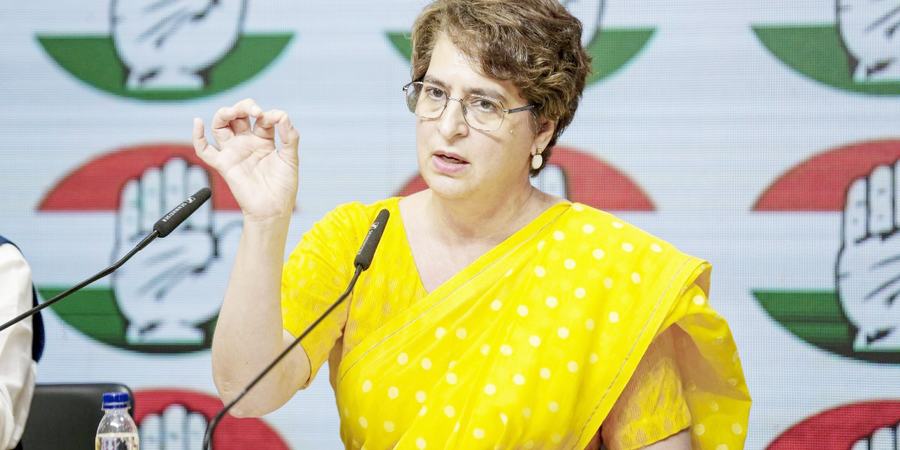
The organisers of a photo exhibition by Rehan Vadra, son of Congress leader Priyanka Gandhi, at Bikaner House in Delhi allegedly pressured him to remove photographs that included images of protests against the government. Although Rehan refused to remove the photographs, only a selected collection of his work will now be displayed at the exhibition.
Priyanka Gandhi has strongly criticised the organisers’ decision and questioned the country’s top leadership. According to a report published by the BBC, she accused the government of imposing censorship on art as well.
It is worth noting that Rehan’s collection included photographs of the Gen Z protests held at Jantar Mantar in Delhi. In a post on Instagram, Rehan himself revealed that two of the photographs he was asked to remove were also related to the national flag.
Meanwhile, his mother, Priyanka Gandhi, shared the photographs on X. In her post, she wrote: “When a powerful person begins to fear another person’s freedom of expression, they may not realise it, but they have already lost the very power they are trying to protect.”
On Wednesday, Rehan Vadra also wrote in his Instagram post that the management of Bikaner House had pressured him to remove most of his photographs.
He further claimed that the photographs depicted youth protests in Delhi and that the organisers apparently found them objectionable.
Rehan said the exhibition would continue in a partially restricted form for the time being. However, he intended to look for another venue where he could display all the photographs related to the protests.
The controversy over the removal of Rehan Vadra’s photographs has prompted the Congress to launch a direct attack on the Modi government.
Congress MP Pawan Khera wrote in a post, “Perhaps the problem is not with the art, but with the government.”
Sharing an image of the empty space left on the wall after the photographs were removed, Khera targeted what he described as the government’s cowardice.
He wrote: “Among the photographs Rehan had to struggle to retain was one depicting the Indian national flag. After the pictures were removed, only the iron nails remained on the empty walls, shining under the spotlights. This was a disturbing symbol of censorship. Imagine a government so afraid of ideas that it cannot tolerate not only protests but also photographs of those protests—and not even the Tricolour.”
Former Rajasthan Chief Minister Ashok Gehlot described the incident as an attempt to silence artists and a direct attack on democracy.
The Indian Youth Congress has announced that it will organise an open-air exhibition of the photographs at a public location on the streets of Lutyens’ Delhi.
It is worth mentioning that Bikaner House belongs to the Rajasthan government, which is currently ruled by the BJP.
The controversy surrounding Rehan Vadra’s photographs could become another political headache for the Modi government. Meanwhile, opposition parties continue to protest against the appointment of Dushyant Gautam as the Governor of Sikkim.
Delhi is witnessing new protests and demonstrations almost every day. The Modi government’s repeated attempts to impose restrictions on these protests are, instead, exposing what critics describe as its insecurity and creating opportunities for the opposition to regain strength and momentum.
Such actions are sending a message to the international community that the government is increasingly rattled and is resorting to every possible tactic to protect its hold on power. However, these measures are only weakening its position further.
The government’s latest move against artistic expression is not an isolated incident. Similar decisions in the past have exposed its authoritarian tendencies and the fear that lies beneath them.
A History of Restrictions on Artistic Expression
The government has subjected the creative works of artists from various fields to what critics describe as unofficial censorship. Filmmakers, cartoonists, writers and other creative professionals have all faced such restrictions.
Three years ago, in 2023, the government banned the screening of a BBC documentary that raised questions about Narendra Modi’s alleged role in the 2002 Gujarat riots. Under the Information Technology rules, links to the documentary, its videos and related tweets were blocked in India.
During the same period, the Central Board of Film Certification (CBFC) ordered the removal of scenes from films that could be interpreted as challenging authoritarianism or expressing views contrary to those of the government.
At the same time, films that critics accused of distorting history and presenting it in accordance with the ideology of the Rashtriya Swayamsevak Sangh (RSS) were allowed to be screened freely. Critics argue that such films have contributed to the spread of hatred and social division.
The film Udta Punjab, which highlighted the growing drug problem in Punjab, also faced extensive cuts by the censor board. At the time, Punjab was governed by a coalition that included the BJP.
In 2026, several cartoons by renowned cartoonist Satish Acharya, which criticised government policies and the Election Commission, were removed from social media platforms. Acharya’s Instagram account was also temporarily blocked.
Meanwhile, critics argue that little effort has been made to prevent individuals who spread venom against minorities from promoting communal hatred. On the contrary, they allege, such elements have often received encouragement.
It is also worth recalling that amendments to the Information Technology rules were introduced in 2021 amid concerns that they could indirectly restrict freedom of expression and suppress voices raised against the government through artistic works. These provisions have also raised concerns about the freedom of stand-up comedians and creators of parody videos.
Several writers have also faced government restrictions on their books.
In August 2025, the Lieutenant Governor of Jammu and Kashmir imposed a ban on 25 books. The list included works by renowned author Arundhati Roy, eminent legal scholar A.G. Noorani, Victoria Schofield and several other prominent writers.
Following the ban, the police raided several bookstalls and seized copies of the prohibited books. Penalties were also announced for their sale.
Yet books accused of spreading hatred and religious divisions in Indian society, or promoting the Hindutva ideology of the RSS, continue to be sold openly in the market.
In September this year, the Jammu and Kashmir government also screened thousands of books held in the libraries of educational institutions and colleges. Approximately 5,000 books were subsequently declared prohibited and removed from the libraries.
Chief Minister Omar Abdullah expressed concern over the move but was unable to prevent the action taken by the Modi government.
The issue has raised questions about interference in the powers of an elected state government. Critics argue that the Modi government has developed a pattern of curtailing the democratic powers and autonomy of opposition-ruled state governments. They see such actions as another manifestation of the Centre’s insecurity and fear of dissent.
The government has also restricted textbooks and removed from the curriculum works that challenge the ideology of the RSS. Several books promoting left-wing perspectives have likewise faced censorship.
The internationally renowned publisher Penguin India withdrew its book An Alternative History from the market following a legal case filed against it. The decision sparked debate among intellectuals in India and around the world, particularly because Penguin is an internationally recognised publishing house.
All these examples suggest that the government views freedom of thought as a serious threat to its authority. Since artists are often the voices of independent thought and expression, their creative works have also become targets of restrictions.
Priyanka Gandhi’s son, Rehan Vadra, and his photographic collection are the latest examples of this pattern.
The government appears to be increasingly apprehensive not only about protests against it but also about exhibitions of photographs depicting those protests. This growing apprehension is reflected in the action taken to remove most of Rehan Vadra’s photographs from the exhibition.
Email: naqvisiraj58@gmail.com
Mobile: 9811602330