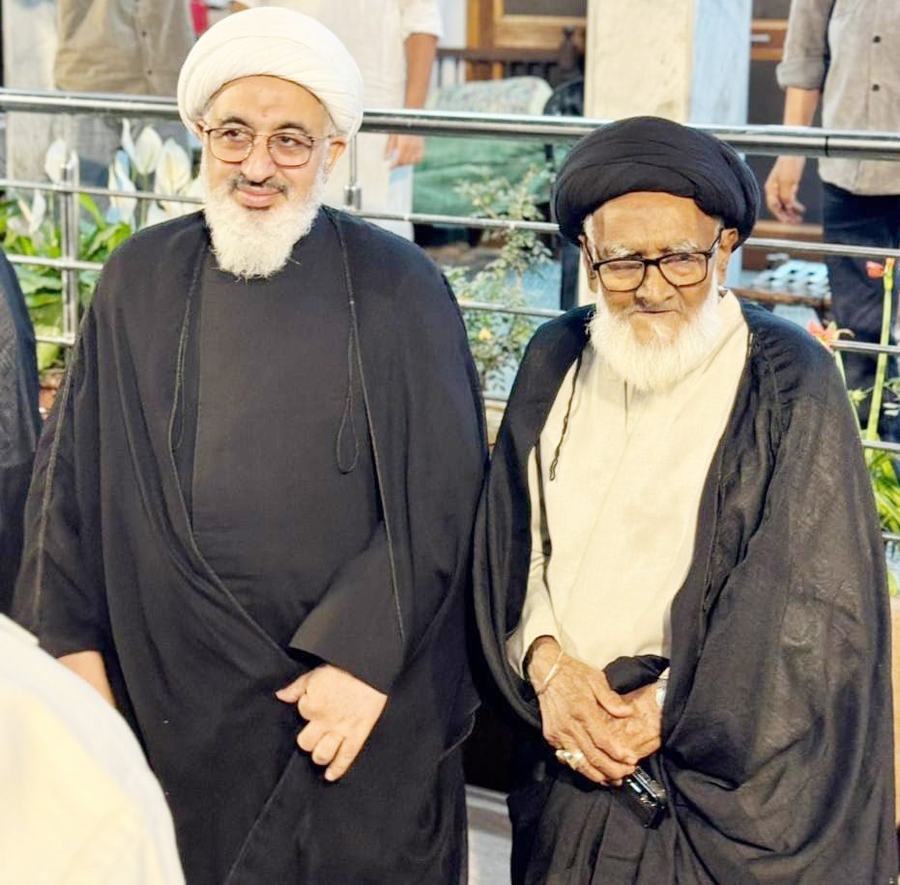
A Personality of Knowledge and Ethics — Maulana Syed Muhammad Siyyadat Fahmi Amrohi
By Siraj Naqvi
Among the Kalimat al-Qisar (short sayings) of Nahj al-Balagha is this wisdom-filled saying of Imam Ali ibn Abi Talib: “Knowledge is the highest form of nobility, and morality is the finest form of kinship.”
This saying demonstrates the fundamental importance that Islam gives to knowledge and morality. If the very first revelation of the Holy Qur’an emphasized knowledge with the command “Iqra” (Read), and if the Prophet Muhammad Mustafa ﷺ is described as possessing “a magnificent character,” then Islam and its scholars cannot be viewed separately from these two qualities: knowledge and morality.
But the question is: What is the true purpose of knowledge, and what is the Islamic standard of morality?
In defining knowledge, Sheikh Saadi Shirazi writes in Gulistan, “Ilm az bahar-e deen parwardan ast,” meaning that knowledge exists for the advancement and service of religion. In other words, a scholar, particularly a religious scholar, has a responsibility to make service to religion the central purpose of his knowledge and efforts, as this is regarded as one of the best ways of attaining the pleasure of God.
The same question raised concerning knowledge also invites reflection on the true essence of religion. The Prophet of Islam ﷺ said that “religion is the name of goodwill and sincere concern.” In this regard, Imam Ali ibn Abi Talib said, “The essence of religion is chivalry and morality.” Imam Ja‘far al-Sadiq also expressed a similar view of religion. In an interrogative tone, he said, “Is religion anything other than love?”
In light of these views concerning knowledge and religion, one point becomes clear: a religious scholar should possess knowledge, morality and love of the kind described above in order to promote and convey the teachings of religion.
Maulana Dr. Syed Muhammad Siyyadat Fahmi Amrohi, who passed away on August 31 at the age of 84 after a brief illness, was a personality who embodied these qualities. Through his knowledge and conduct, while upholding morality and love, he established a distinct identity not only among the people of Amroha but also among various scholarly, religious and intellectual circles across the Indian subcontinent. He lit lamps of knowledge that will continue to illuminate the minds of scholars for a long time to come.
His knowledge, morality and sincerity made him a true heir to the nobility of his family, which has been respected for generations for its services to religion and knowledge. In Amroha, a city renowned for its scholarship and literature, it is difficult to find another family that has attained such a distinguished position through breadth of knowledge, good character and righteous conduct.
The family also has the distinction of producing scholars who were accomplished writers and distinguished poets. Maulana Siyyadat Fahmi demonstrated his literary abilities in both fields. Mir Anees was proud to say that he had been praising Imam Hussain for five generations, but Maulana Dr. Muhammad Siyyadat Naqvi’s family has the distinction of having seven generations who served as Friday and congregational prayer leaders in Amroha, a city of scholars, while also remaining active in the fields of knowledge and literature. Their literary contributions have been widely recognized.
Dr. Syed Muhammad Siyyadat Fahmi not only preserved the family tradition of serving religion and literature from generation to generation, but also carried it forward through his writings, adding a new chapter to it. The establishment of the Maulana Muhammad Ibadat Educational Society and the Saloni Educational Centre is evidence of this.
His respected father, Maulana Muhammad Ibadat, a former Imam of Friday and congregational prayers, passed away in 1989. After his father’s death, Maulana Siyyadat took on this important responsibility. However, his energetic personality and passion for promoting knowledge encouraged him to take further initiatives in the field of education.
As part of these efforts, the Maulana Muhammad Ibadat Educational Society was established in 1995. The society made the promotion of education and training among women and children one of its primary objectives and carried out constructive work that was recognized by various scholarly circles in Amroha and beyond.
The International Shahid Motahari Award, presented by the Government of Iran in 2009, was significant evidence of this recognition. The award is given for improving teaching practices, introducing new educational methods, conducting research and making notable contributions to education. It is also awarded for translating Islamic literature and promoting Islamic thought. Maulana Siyyadat’s receipt of this award was an acknowledgment of his important contributions to the field of knowledge.
One notable aspect of the Maulana Muhammad Ibadat Educational Society is that it arranged free coaching for girls in the community. This included coaching in modern academic subjects. Giving priority to women’s education among the society’s educational activities was presented as being consistent with the teachings and values of Allah, the Prophet ﷺ and the Imams.
The Prophet of Islam ﷺ is quoted as saying that whoever has a daughter, teaches her the best manners and provides her with higher education will have that daughter as a means of protection from the fire of Hell. Imam Ali is also quoted as saying that a woman is the moral and intellectual guardian of society.
Clearly, if women are regarded as the intellectual and moral guardians of society, Islam cannot approve of neglecting their education. Imam Ja‘far al-Sadiq is also quoted as saying that a greater share of goodness and virtue has been placed in women.
It is also mentioned in religious traditions that women attended Imam Ja‘far al-Sadiq’s lessons while observing the required privacy and learned Hadith and jurisprudence. Lady Fatima al-Zahra played an important role in educating the women of Medina, providing significant evidence of the importance of women’s education in Islam. Her daughter, Lady Zaynab, also played an important role in educating the women of Kufa when Imam Ali was caliph and Kufa was his capital. She became known as “Aqila of Quraysh” and “the learned one who was not taught.”
In view of these facts concerning women’s education in Islam, any educational institution established according to Islamic values has a responsibility to plan specifically and give priority to women’s education. In this regard, the establishment of the Maulana Muhammad Ibadat Educational Society by Dr. Muhammad Siyyadat and its provision of free coaching for women demonstrate his positive and Islamic approach to education.
The society was also active in organizing seminars and symposia and publishing books. Another notable educational initiative of Maulana Siyyadat was the establishment of the Saloni Educational Centre. Approved by the state government, the centre provides free education to students up to the fifth grade.
Another important aspect of his educational services was his decision to dedicate himself to teaching, keeping the fundamental objective of promoting knowledge in mind. His journey to becoming Head of the Urdu Department at J.S. Hindu Degree College, Amroha, was an important part of his contribution to education.
He received his early education at Syed-ul-Madaris, Amroha, obtained qualifications in Arabic and Persian, then completed an M.A. in Urdu from Aligarh Muslim University and a Ph.D. from Rohilkhand University on the topic “Ali Nazar Hayat and Poetry.” He subsequently joined the Urdu Department of Hindu Degree College in Amroha.
During his association with the institution, several renowned writers and poets obtained Ph.D. degrees under his supervision on various subjects. Among them, the well-known marsiya writer and researcher of elegiac literature, Dr. Azim Amrohi, deserves particular mention. Several other prominent names were also among his students.
Maulana Siyyadat himself studied poetry under two important figures. Initially, he had the privilege of becoming a disciple of the internationally renowned poet and writer Jaun Elia. After Jaun Elia migrated to Pakistan, Maulana Siyyadat began receiving literary guidance from his respected father, Maulana Muhammad Ibadat, who was himself a distinguished writer and poet. His collection of poetry is evidence of his literary stature.
Maulana Muhammad Ibadat’s father, and therefore Maulana Siyyadat’s grandfather, Maulana Aulad Hasan Saleem, was also a prominent religious scholar of his time and was regarded as an accomplished poet.
Maulana Syed Muhammad Siyyadat used Fahmi Amrohi as his poetic pen name. His poetry reflects the maturity of his thought and his command over various subjects. Even in this field, particular importance was given to the ethical dimension of his thinking.
Although the list of Maulana Siyyadat’s prose works is not particularly long, whatever subject he chose to write about was treated with depth and seriousness. His choice of subjects also provides an insight into his intellectual priorities.
He received an award from the Uttar Pradesh Urdu Academy for his work Nasim Amrohi: Ek Taaruf (“Nasim Amrohi: An Introduction”). Nasim Amrohi is regarded as one of the pioneers of the modern Urdu marsiya. He was not only a distinguished marsiya writer but also made extensive contributions to other literary genres. He made notable contributions to the preparation of textbooks as well.
Writing about such a multifaceted personality itself demonstrates the priorities of Maulana Siyyadat’s literary work. In addition, he wrote an important critical and research-based book on Ghalib’s poetry titled Gufta-e-Ghalib.
His other two books demonstrate his deep interest in and commitment to Islamic values, as they deal with subjects that can be regarded as intellectual and ideological foundations of an Islamic society. One of these works deals with the important subject of “Islam, Socialism and Capitalism,” while the other is titled “The Islamic Theory of Justice.”
The first of these works, Islam, Socialism and Capitalism, discusses what the author presents as the important principle of intellectual balance and moderation found in Islamic teachings. The article argues that socialism, in its opposition to capitalism, became so imbalanced that it rejected private ownership and did not allow individuals the freedom to accumulate wealth through their own labour and abilities.
According to the article, the socialist system supports an unrealistic and practically impossible concept of the equitable distribution of wealth. While supporting workers’ rights, it rejects the principle of wealth acquired through individual effort.
Capitalism, on the other hand, is described as concentrating wealth in the hands of a small number of capitalists and restricting workers’ rights to acquire wealth. The article therefore argues that both systems conflict with the Islamic concept of moderation and can lead individuals toward extremes in different ways.
Islam, the article explains, teaches people to avoid such extremes. The Prophet of Islam ﷺ is quoted as saying, “Pay the worker his wages before his sweat dries.” At the same time, those who hoard goods and create inflation in the market by storing grain or other commodities are described as sinful, and the Prophet ﷺ is reported to have condemned such hoarding.
Imam Ali ibn Abi Talib is quoted as saying, “I have never seen wealth accumulated beyond a person’s needs without the right of a poor person being neglected beside it.” Most of the Imams also taught moderation in economic affairs.
This brief discussion illustrates the importance given to a balanced economic system in Islam and explains why both capitalism and socialism are criticized from the perspective presented in Maulana Siyyadat’s work. His decision to write on such an important subject is presented as arising from his awareness of religious issues and his desire to create greater awareness of them within Islamic society.
The second important work by Dr. Muhammad Siyyadat is “The Islamic Theory of Justice.” Just as economic moderation is presented as an integral part of an Islamic society, a righteous Islamic society cannot be imagined without a system of justice. Indeed, the article argues that these two principles form part of the same intellectual framework.
The concept of justice presented by Islam to the world is based on the fair distribution of rights and responsibilities. The article states that this concept of justice can be found throughout the Holy Qur’an, the sayings of the Prophet and the words and actions attributed to the Imams.
The caliphate of Imam Ali is particularly noteworthy in this regard. During his own period as caliph, as well as during the periods of the earlier Rightly Guided Caliphs, his decisions are presented as having offered new approaches toward establishing an Islamic system of justice.
The Prophet Muhammad ﷺ is quoted as saying, “It is through justice that the earth and heavens are sustained.” He is also quoted as saying that “one moment of justice is better than seventy years of worship, whose nights are spent in prayer and whose days are spent fasting.”
Regarding Imam Ali’s commitment to justice, the article notes that even Western thinkers acknowledged it. The renowned Christian writer George Jordac wrote a book on the subject titled Ali: The Voice of Human Justice, offering tribute to Imam Ali as a just ruler. Edward Gibbon, Thomas Carlyle and Madame Dieulafoy are also mentioned among Western thinkers who openly acknowledged Imam Ali’s justice.
Maulana Dr. Syed Muhammad Siyyadat’s book The Islamic Theory of Justice is particularly noteworthy because it focuses specifically on the justice of Imam Ali. In the introductory section of the book, the author writes that Islam is the way of life that awakens awareness of the social importance and necessity of justice and encourages human beings to make justice a natural part of their practical lives.
The author further writes that the Qur’an repeatedly sheds extensive light on this important subject, while the Prophet Muhammad ﷺ explained the Qur’anic principles through his words and actions and established justice as a defining characteristic of humanity.
He further describes Nahj al-Balagha, the collection of Imam Ali’s sermons and letters, as a vast ocean of human virtues from which progressive minds of every era can discover rare and valuable pearls that illuminate the values of life.
The author also expressed regret at the limited availability of Urdu literature on this subject. While books dealing with justice in Nahj al-Balagha have appeared in Arabic, Persian and other languages, the article notes that, apart from Urdu translations of Nahj al-Balagha, there had not been a significant Urdu work comprehensively examining its ideas and theories, particularly those concerning justice.
It was this realization, the article explains, that inspired the author to make “The Islamic Theory of Justice” the subject of his study. The author himself acknowledges this in the introductory section of the book.
In conclusion, the two works written on the Islamic theory of justice and the Islamic approach to economics demonstrate the author’s deep connection with and interest in Islamic thought. There is no need, the article suggests, to explain further the central role of justice and a practical, balanced economic system in building an Islamic society.
In this sense, Maulana Siyyadat placed these subjects at the centre of his literary work and, in doing so, fulfilled the responsibility of conveying religious teachings while presenting various dimensions of Islamic ethics through his writings. He also demonstrated these principles in his social life.
According to the article, this quality earned him acceptance among people belonging to different religions and schools of thought. Now that he is no longer among us, the void created by his death is one that, the article concludes, will not be easy to fill.