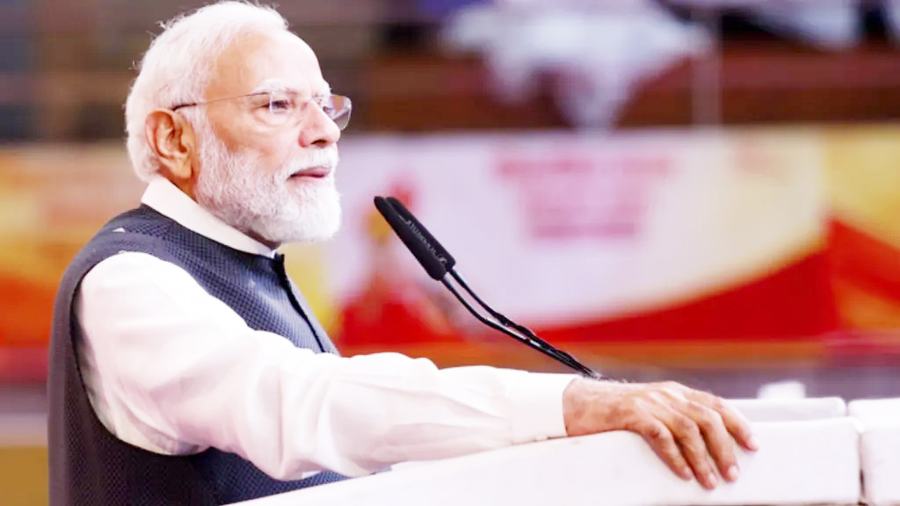
Completing 25 Years in Power as Gujarat Chief Minister and Subsequently as Prime Minister of India
The statement made by Prime Minister Narendra Modi on October 7, marking the completion of 25 years in power, is an example of how adept he is at making claims about his image-building that may have little, if anything, to do with reality.
On October 7, the Prime Minister was addressing the ‘Viksit Bharat Sankalp Sabha’ programme to mark the completion of 25 years of his tenure in power. Among other things, he said, “The journey of 25 years of public service is not an occasion for personal publicity, but a day to reaffirm our commitment to a developed India.”
The author is neither expressing any doubts about the Prime Minister’s claim nor directly disputing it. However, the facts available in the public domain do not confirm his assertion. On the contrary, they suggest that no other Prime Minister in the country’s history has given personal publicity as much prominence as Mr Modi has. It is possible that the Prime Minister himself may not have played a direct role in every instance, but it is undeniable that he has remained silent as new records have been set in promoting his image. There have also been numerous instances during this period in which other party leaders and even constitutional authorities appeared to have been sidelined in favour of Mr Modi. How should such developments be interpreted?
Opposition parties have repeatedly alleged that enormous amounts of public money have been spent on Mr Modi’s image-building during his tenure. Similar allegations were made against former Prime Minister Indira Gandhi, particularly during the Emergency, when her photographs and statements were widely publicised through official channels. However, in Mr Modi’s case, the issue goes beyond his photographs appearing in government advertisements. In numerous sectors, the government’s achievements have been presented primarily through praise of Mr Modi, creating the impression that a single individual is responsible for the work of the entire government—and that individual is Mr Modi.
Although similar practices existed before the Modi government, the amount spent on promotional campaigns associated with him since he became Prime Minister has reportedly set new records. This is not merely a question of spending more money on publicity than previous governments did. Even when expenditure is assessed proportionately, the scale is said to be unprecedented, despite rising inflation and the declining value of the rupee.
An RTI disclosure reportedly revealed that since the Modi government came to power in 2014, several thousand crore rupees have been spent on print, electronic and outdoor advertising. The Prime Minister’s image, naturally, has featured prominently in these advertisements. Nor is the issue confined to government expenditure. There have also been reports of substantial spending on advertising campaigns from party funds.
It is no secret that Mr Modi has undertaken an exceptionally large number of foreign visits during his tenure as Prime Minister. Beyond the number of visits made at public expense, a notable feature of many such trips has been the organisation of large public events for him by overseas branches of the BJP. People of Indian origin in the countries concerned have been invited to attend these gatherings, often at considerable expense. The slogans of “Modi, Modi” raised at these events cannot simply be taken as an unqualified measure of his popularity. Reports have also emerged of attendees claiming that they were pressured to participate in such programmes.
It is also widely perceived that many official events have been organised in a manner that makes it difficult to distinguish between government programmes and BJP events designed to promote Mr Modi’s image. The Trinamool Congress (TMC) has claimed that Rs 2,586 crore was spent on Mr Modi’s publicity between 2020 and 2026 alone. The Congress has repeatedly alleged that a campaign is under way to create a personality cult around a single individual—Mr Modi.
During the Covid pandemic, there was considerable criticism over the inclusion of Mr Modi’s photograph on Covid-19 vaccination certificates. These certificates were not associated with any particular government development project, and critics questioned the justification for featuring the Prime Minister’s photograph on them. The Prime Minister himself could have intervened and had his photograph removed. Had he done so, it might have supported the claim that he avoids personal publicity. Similarly, the appearance of his photograph on ration bags distributed to poor people, the packaging of government medicines and materials associated with public welfare schemes does not sit comfortably with his assertion.
Before the 2024 parliamentary elections, the Congress complained to the Election Commission, alleging that government advertisements carried messages resembling the BJP’s election slogans. It also alleged that public funds were being used to support the party’s publicity campaign. It is evident that Mr Modi’s face has generally been far more prominent than that of the BJP president in the party’s advertising campaigns. What stronger evidence of personal promotion could there be? Whether Mr Modi himself wanted this level of publicity is, of course, a separate question.
There have, however, been several public occasions when what might be described as Mr Modi’s fondness for the camera has been particularly evident. On a number of occasions, he has reportedly asked security personnel standing in front of him to move aside when their presence might affect his photograph. During his tenure, there have also been instances in which particular incidents were presented as spontaneous, creating the impression that Mr Modi was a simple-hearted leader who could establish a direct connection with ordinary people. However, when some investigative journalists examined these incidents, they reportedly found that certain events had been staged or carefully planned to improve his public image.
Consider the photograph circulated widely in 2014 showing Mr Modi holding a broom and sweeping a floor. The image was used to project him as a simple and down-to-earth personality. However, an RTI response subsequently reportedly indicated that the photograph was fake.
Even if Mr Modi had no role in circulating the photograph, why was no legal action taken against those responsible? During the Swachh Bharat Abhiyan, photographs of the Prime Minister sweeping public places and removing rubbish from roads were widely publicised by the government and the BJP themselves. If the repeated display of his photographs on International Yoga Day is not personal publicity, what is? The same question can be asked about the viral videos showing him conversing with a Muslim passenger on a metro train or talking to ordinary people in villages and small towns.
Let us set aside these examples, as it is possible that the Prime Minister himself had no direct role in their circulation. But what does wearing a suit reportedly worth Rs 10 lakh or watches priced between Rs 50,000 and Rs 60,000 signify? When the Prime Minister of a developing country adopts such a conspicuous style of dress and presentation, does it not raise questions about the role of personal image-building?
The suit worth Rs 10 lakh mentioned above was worn by Mr Modi in 2015, when then US President Barack Obama visited India. Its most striking feature was the fine gold embroidery of the words “Narendra Damodardas Modi” across the fabric. Was this not an instance of personal promotion? It is a separate matter that, following public criticism, the suit was later auctioned for more than Rs 4 crore, with the proceeds deposited in the government treasury.
Whatever the explanations offered for these incidents, they do not substantiate Mr Modi’s assertion that he refrains from personal publicity.
Mobile: 9811602330