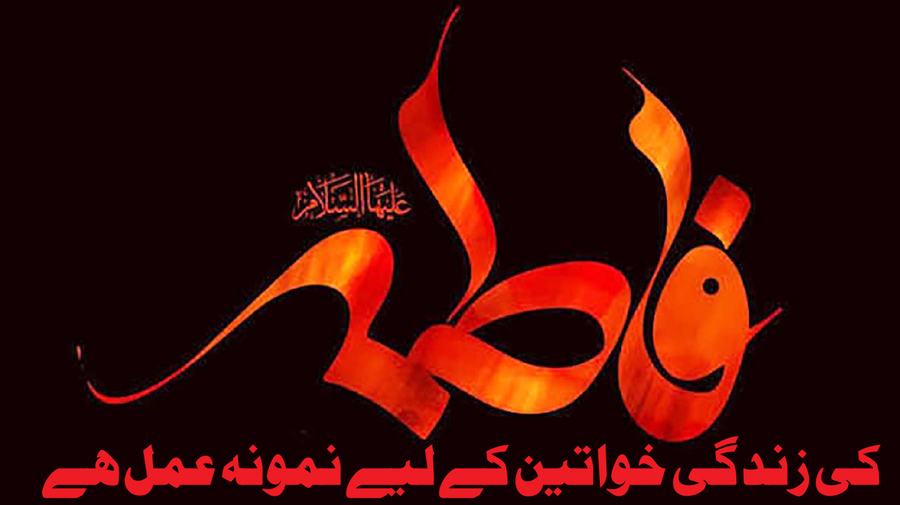
If we examine the blessed life of Hazrat Fatima Zahra (peace be upon her), we find that her life serves as an excellent model and an exemplary guide for women throughout the world. As the beloved daughter of the Holy Prophet Muhammad (peace and blessings be upon him and his family), Hazrat Fatima Zahra performed deeds during her lifetime that continue to serve as an example for women until the Day of Judgment. She fulfilled the role of a mother in such an extraordinary manner that her example remains unparalleled. After marriage, she also fulfilled the role of a wife with such devotion and excellence that no parallel can be found throughout history. Hazrat Ali (peace be upon him) himself spoke on numerous occasions about Fatima’s character, morals, and conduct.
The daughter of the Messenger of Allah fulfilled the role of a daughter so beautifully that when the leader of the prophets (peace and blessings be upon him) felt physically weak, he would come to his daughter’s door and find comfort and relief. It was for this very daughter that the Final Prophet declared: “Fatima is a part of me. Whoever hurts Fatima hurts me, and whoever hurts me hurts Allah.” And a person who hurts Allah cannot truly be a Muslim. This hadith indicates that Fatima’s displeasure is, in fact, connected to the displeasure of Allah. Therefore, those who oppose Fatima or cause her suffering incur Allah’s displeasure, and their deeds are rendered invalid.
After the passing of the Holy Prophet (peace and blessings be upon him), when the issues of the caliphate and Fadak arose, Sayyida Fatima (peace be upon her) delivered the historic Sermon of Fadak in the Prophet’s Mosque. This remarkable sermon shook the conscience of the Muslim community. Citing verses from the Holy Qur’an, she argued that the Qur’an clearly establishes that prophets leave inheritance. She challenged the claim that prophets do not leave inheritance, arguing that any narration contradicting the Qur’an cannot be accepted as authentic. Through the Qur’an itself, she sought to demonstrate that the ruler of the time was not merely in opposition to the Ahl al-Bayt, but was also acting contrary to the Qur’anic teachings. She further argued, on the basis of the Qur’an, that knowledge, courage, and piety are qualities of the highest importance in determining rightful leadership, and that the rightful claim to the caliphate belonged to Imam Ali (peace be upon him).
The Holy Prophet Muhammad (peace and blessings be upon him and his family) expressed his daughter’s honour and exalted status through numerous traditions. On one occasion, he referred to Fatima as “the mother of her father.” Out of profound respect and affection, the Messenger of Islam would stand up whenever Fatima came to him and would offer her his own seat.
Yet, after the Prophet’s death, the Muslim community treated Fatima in a manner that compelled the Prophet’s daughter to express her grief in poetry:
“After you, O Father, calamities have befallen me; had they descended upon the bright days, they would have turned them into dark nights.”
This was why, after the passing of the Messenger of Allah, the true attitude of certain sections of the community began to emerge, and the hostility that had been developing towards the Ahl al-Bayt gradually became apparent. Could the community have been unaware of what the Messenger of Allah had said about his Ahl al-Bayt? He had repeatedly emphasised their honour and dignity, leaving no opportunity unused to teach his Companions and the wider Muslim community the importance of respecting and honouring them.
Today, the enemies of this community understand very well that, in order to dominate it and impose their control upon it, they must weaken the flame of its faith and convictions. This is why they sometimes portray weeping and mourning for Sayyid al-Shuhada, Imam Hussain (peace be upon him), as something meaningless, while at other times they raise doubts about the martyrdom of Hazrat Fatima Zahra (peace be upon her). Yet, within the historical and religious tradition that upholds her martyrdom, this event is regarded as an established truth. Those who seek to undermine it may attempt to create doubts about the martyrdom of Hazrat Zahra, but they cannot erase the suffering and hardships endured by the daughter of the Messenger of Allah after his passing.
Hazrat Fatima was a woman who, despite facing the most severe hardships and profound oppression, stood firm even in the extraordinarily difficult circumstances following the death of a father like the Holy Prophet (peace and blessings be upon him). At a time when an ordinary person might have been unable even to speak, she delivered a powerful and compelling sermon before the rulers and prominent figures of the community. It is astonishing to consider how a woman, amid such grief and under such circumstances, could deliver a sermon of such strength, precision, and intellectual depth. Her discourse addressed profound questions concerning monotheism, prophethood, and Imamate. At the same time, she rebuked those who had abandoned their divinely ordained responsibilities in pursuit of worldly comfort and pleasure, and those who had remained mere spectators in the face of oppression and injustice.
The character of Hazrat Fatima Zahra (peace be upon her), particularly in the period following the passing of the Holy Prophet, serves as a mirror through which the Muslim community can distinguish between truth and falsehood. According to this perspective, standing with her cause is an expression of faith, while opposing her represents a grave departure from the principles of faith and a manifestation of hypocrisy. Rather than relying on worldly power, she exposed falsehood through morality, knowledge, and patience, laying down principles of truth that would endure until the Day of Judgment.
Sadly, even after fourteen centuries, we have failed to recognise this incomparable treasure fully. More regrettable still is the fact that ignorance, foolishness, and the pursuit of selfish desires have led some people to view her exalted position and spiritual stature with doubt and scepticism. The truth is that it is difficult for an ordinary human being to comprehend how a woman could attain such a lofty spiritual rank that her will becomes a point of reference for the will of Allah.